

Reclaiming the Foundations of Islamic Education
When we talk about the history of education in Islam, the conversation often centers around great male scholars, grand mosques, and ancient libraries. But there is a story that is rarely told loudly enough. It is the story of women who taught, learned, debated, and shaped the intellectual foundation of the Muslim world long before the modern world began debating whether women deserved education at all.
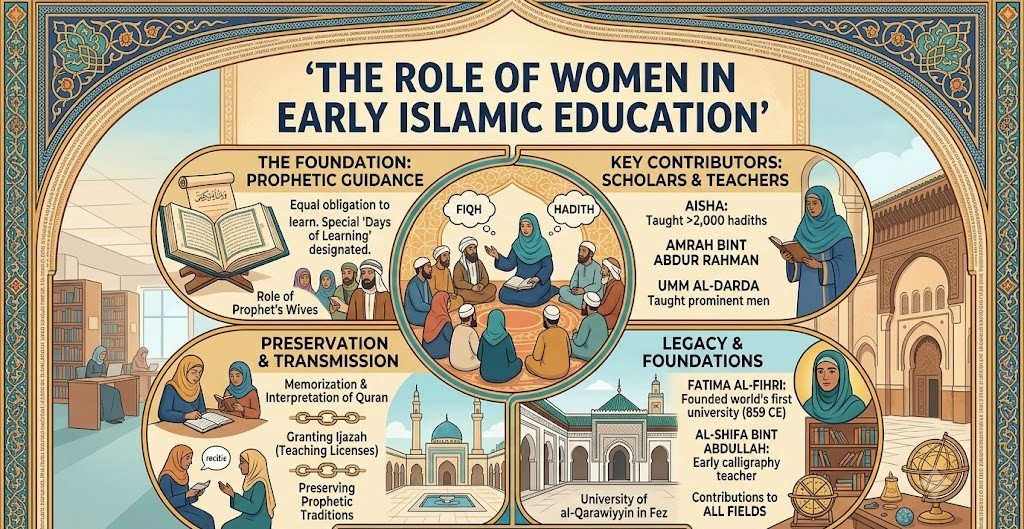
It begins with a single powerful hadith: "Seeking knowledge is an obligation upon every Muslim." Every Muslim. No gender exception. No footnote. The Prophet Muhammad (PBUH) not only encouraged women to seek knowledge in Islam but also actively made space for it. Women would approach him directly with questions about theology, Islamic law, and personal matters. He never turned them away. He answered, he engaged, and he respected. In the 7th century Arabia, that was not normal. It was revolutionary.
No story captures the role of Muslim women in education better than that of Hazrat Aisha (RA). She was the wife of the Prophet (PBUH), yes, but she was also one of the greatest Islamic scholars in history, regardless of gender. She narrated over 2,200 hadiths. Senior male companions would travel to her to verify religious rulings and clarify matters of Islam. Scholars sat outside her door just to listen. Imam Az-Zuhri once remarked that if the knowledge of Aisha were placed on one side of a scale and the knowledge of all other women on the other, Aisha's side would be heavier. She was not just educated. She was an authority.
And she was not alone. Hazrat Fatimah Al-Fihri founded the University of al-Qarawiyyin in Fez, Morocco, in 859 CE, recognized by UNESCO as the oldest continuously operating university in the world. A Muslim woman built the world's first university. That single fact deserves to be repeated in every classroom every semester. Hazrat Umm Salamah (RA) was known for her sharp intellect and was consulted on important religious matters by the companions of the Prophet (PBUH). Hafsa bint Sirin was a female Islamic scholar of hadith and Quranic recitation who taught both men and women, cited by major classical scholars as a reliable and respected narrator.
What is striking is not just that these women existed. It is that they thrived. They debated. They corrected errors. They issued fatwas. They ran institutions. All of this was documented, preserved, and respected by the scholars who came after them. The history of women scholars in Islam is not a modern invention or a feminist reinterpretation. It is recorded in the same classical books that record the male scholars.
Yet somewhere along the way, this history got buried. The women of early Islam disappeared from the mainstream narrative, replaced by a version of Islamic history that was almost entirely male. For students of Islamiat in Pakistan and across the Muslim world, this matters deeply because the restriction of women's education in many Muslim societies today is not rooted in Islamic teachings. It is a cultural failure dressed in religious clothing.
Islam, at its foundation, never treated knowledge as a male privilege. The women of early Islamic history did not ask for permission to learn. They learned because their faith demanded it. They taught because their community needed it. They left behind a legacy so powerful that fourteen centuries later, we are still quoting them, studying them, and standing on their shoulders.
It is time we told their story loudly, proudly, and often.


